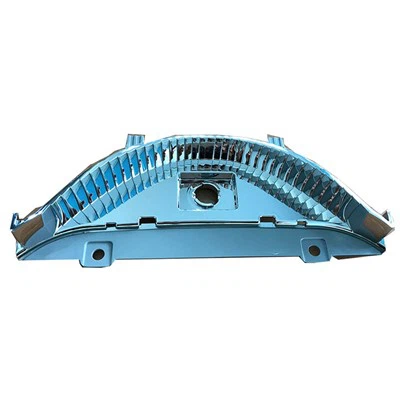
Supplier Home Stamping Die Mould
Stamping is a process of applying pressure to sheets, strips, tubes, and profiles by means of a press and die to achieve material separation or plastic deformation. The following are the five basic processes of stamping, each with its own specific purpose and application.
1. Blanking: This process involves separating the sheet into different parts, including punching (making holes) and blanking (cutting out parts of the desired shape). In addition, it also includes trimming (removing excess material from the edges) and sectioning (cutting materials to obtain parts of specific sizes).
2. Bending: This process is used to produce plastic deformation at the edge of the material, so that the material bends along a curve to form the desired angle and shape. This is very common when manufacturing parts such as bends or brackets.
3. Stretching: The stretching process converts flat sheets into three-dimensional parts with various openings, or further deforms parts that already have three-dimensional shapes. This process can produce cup-shaped parts or box-shaped parts with different depths.
4. Fine blanking: Fine blanking is used to manufacture products that require high precision and high quality. It uses high-precision molds to ensure that the part size and surface quality meet extremely high standards, and is suitable for manufacturing precision parts.
5. Local forming: This process changes the shape of the material by causing local plastic deformation on the material. This includes flanging (increasing the thickness of the edge of the material), bulging (making the material bulge in a certain area to form a bulge), leveling (eliminating the unevenness of the material surface) and shaping (changing the shape of the material).

Supplier Home Stamping Die Mould
1. High precision Stamping molds adopt mold design and manufacturing processes and are characterized by high precision. The use of advanced technologies such as CNC technology can greatly improve the production.
2. Simple process The stamping mold process is simple and can produce various complex parts. Compared with other forming processes such as casting and forging, stamping molds have the advantages of low production cost, high iciency, and eff gyiciency, and low energy consump.
3. High production efficiency Stamping dies have the advantage of high mass production efficiency. Molds can be processed in batches to produce identical parts in large quantities. This mass production can be completed in an instant, sign. instant, significantly imving production.
4. Strong adaptability Stamping molds can be designed and manufactured according to different production needs, so they are more adaptable when handling the production of different parts.
5.Long service life Since the stamping mold is made of high- quality materials and sophisticated processing technology, it has a long service life. In addition, the stamping mold is not easily damaged and can be reped and modified. reduce parts replacement and maintenance costs.