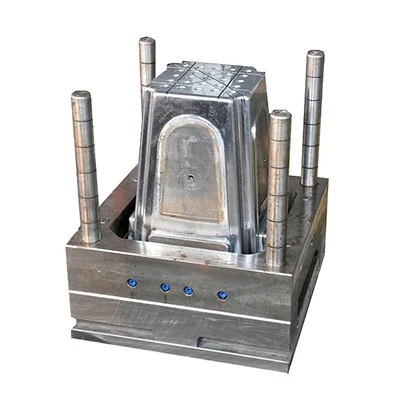
Die Casting Polishing Scroll Wheel
Advantages of die casting include excellent dimensional accuracy of the casting. This usually depends on the casting material, and typical values are 0.1 mm for the first 2.5 cm dimension and 0.002 mm for each additional cm. Compared with other casting processes, its casting surface is smooth, and the radius of the fillet is about 1-2.5 microns.
Compared with sandbox or permanent mold casting, it can produce castings with a wall thickness of about 0.75 mm. It can directly cast internal structures, such as wire sleeves, heating elements, and high-strength bearing surfaces. Some other advantages include that it can reduce or avoid secondary machining, fast production speed, casting tensile strength up to 415 MPa, and can cast high-fluidity metals.

Die Casting Polishing Scroll Wheel
The metals used for die casting mainly include zinc, copper, aluminum, magnesium, lead, tin and lead-tin alloys. Although die casting iron is rare, it is also feasible. More special die casting metals include ZAMAK, aluminum-zinc alloys and the standards of the American Aluminum Association: AA380, AA384, AA386, AA390 and AZ91D magnesium.
The characteristics of various metals when die casting are as follows:
Zinc: The easiest metal to die cast, it is very economical when making small parts, easy to coat, high compressive strength, high plasticity, and long casting life.
Aluminum: Light weight, high dimensional stability when making complex and thin-walled castings, strong corrosion resistance, good mechanical properties, high thermal conductivity and electrical conductivity, and high strength at high temperatures.
Magnesium: Easy to machine, high strength-to-weight ratio, the lightest of the commonly used die casting metals.
Copper: High hardness, strong corrosion resistance, the best mechanical properties among the commonly used die casting metals, wear resistance, and strength close to steel.
Lead and tin: High density, extremely high dimensional accuracy, can be used as special corrosion-resistant parts.

Die Casting Polishing Scroll Wheel

Die casting coating
In the die-casting process, coatings are used to avoid welding between castings and die-casting molds, reduce the friction resistance of casting ejection, and avoid excessive heating of die-casting molds. Requirements for coatings:
1) Good lubricity at high temperatures;
2) Low evaporation point, the diluent can evaporate quickly at 100-150℃;
3) No corrosion to die-casting molds and die-castings;
4) Stable performance, the diluent should not evaporate excessively in the air and become thick;
5) No harmful gases will be precipitated at high temperatures;
6) No scale will be deposited on the surface of the die-casting cavity.